How Much Does a Brompton Weigh? C Line vs. P Line vs. T Line
When choosing a Brompton, weight is more important than it might seem.
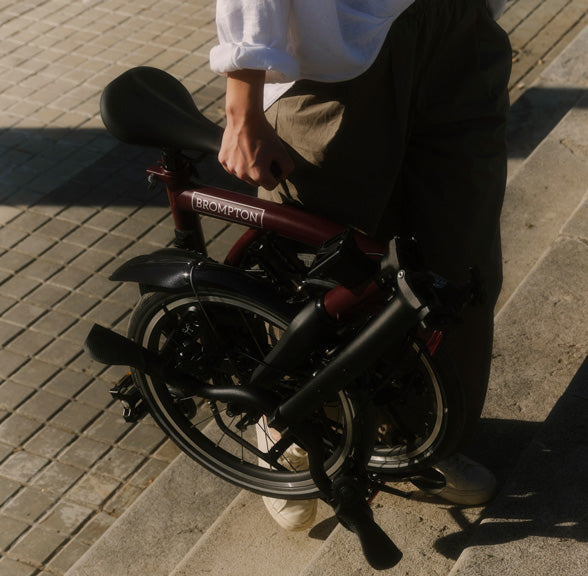
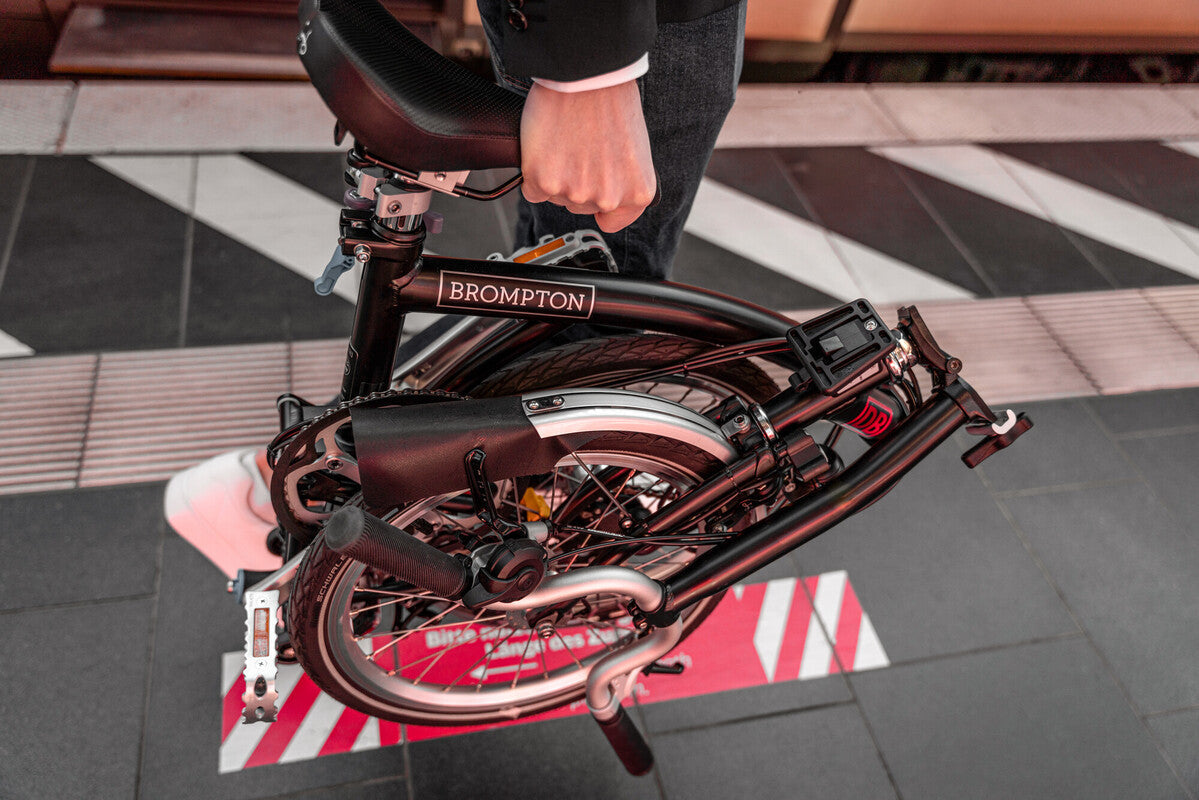
A Brompton is designed to be folded, carried, stored, and taken with you. Whether you’re carrying it up a flight of stairs, onto a train, into an office, or through an airport, every pound matters.
The 2026 C Line, P Line, and T Line all use Brompton’s compact folding design and 12-speed gearing, but there is a significant difference in weight between them.
|
Brompton Line |
Approx. Weight |
Difference from C Line |
|
C Line 12-speed |
27 lb |
— |
|
P Line 12-speed |
24 lb |
3 lb lighter |
|
T Line 12-speed |
Just under 20 lb |
About 7 lb lighter |
So, which one should you choose?
C Line: About 27 lb
The C Line is the standard against which the other Bromptons are measured.
Its all-steel construction gives it a solid, familiar ride feel, while keeping the price lower than the lightweight P and T Lines. At around 27 lb, it’s still remarkably portable for a full-featured 12-speed bicycle.
For many riders, the C Line is the right choice because weight simply isn’t a big enough factor to justify paying more.
Choose the C Line if:
- You want the best balance of price, durability, and portability
- You carry your Brompton occasionally rather than constantly
- Most of your riding is commuting, errands, and everyday cycling
- You value the classic feel of an all-steel Brompton
The C Line is especially appealing if your Brompton spends most of its time on its wheels rather than on your shoulder.
P Line: About 24 lb
At around 24 lb, the P Line saves roughly 3 lb compared with the C Line.
Three pounds might not sound like much, but you notice it when you’re carrying a folded Brompton. The P Line is also designed around a lighter, more performance-oriented specification, giving it a quicker, more responsive feel.
This makes the P Line an excellent middle ground: you get a meaningful weight reduction without moving all the way up to the price of a T Line.
Choose the P Line if:
- You regularly carry your Brompton
- You use stairs or public transit during your commute
- You want a lighter, more responsive bike
- You want to save weight without paying for the T Line
For many riders, the P Line is the sweet spot between the C Line and T Line.
T Line: Just Under 20 lb
Then there’s the T Line.
At just under 20 lb for the 12-speed, the T Line is roughly 7 lb lighter than a C Line and about 4 lb lighter than a P Line.
That’s not a small difference.
A sub-20-lb Brompton feels dramatically different when you’re carrying it. It is easier to lift into a car, carry through a train station, take up stairs, or move around an office or hotel.
The T Line achieves this through its extensive use of lightweight materials, including titanium and carbon fibre.
Choose the T Line if:
- Carrying your Brompton is a regular part of your day
- You travel frequently with your bike
- You want the lightest Brompton possible
- Weight is more important to you than price
- You appreciate high-end materials and engineering
The T Line isn’t simply a lighter C Line. It’s designed for riders who are willing to pay more to minimize weight and maximize portability.
Is 7 Pounds Really That Important?
It depends on how you use your Brompton.
If you fold your bike at the beginning and end of your commute and rarely carry it, the difference between 27 lb and 20 lb may not matter much.
But if you’re carrying your Brompton several times every day, the difference adds up.
Consider a typical trip involving a flight of stairs, a train platform, a station connection, and another flight of stairs at the other end. That’s several occasions where you’re lifting the bike rather than riding it.
In that situation, 7 lb is a difference you’ll feel every time.
This is why we don’t think of the T Line simply as the “best” Brompton. It’s the best choice for a particular type of rider: someone who places a very high value on low weight.
Which Brompton Weight Is Right for You?
A simple way to think about the three Lines is:
C Line — 27 lb:
The best choice for most riders. Excellent balance of price, durability, ride quality, and portability.
P Line — 24 lb:
The lightweight sweet spot. A noticeable reduction in weight for riders who carry their bike regularly.
T Line — just under 20 lb:
The ultimate lightweight Brompton. Ideal for frequent carrying, travel, and riders who want the lightest possible package.
There’s no magic weight at which a Brompton suddenly becomes “light.” Instead, think about how often you will actually have to carry your bike.
If it’s once in a while, the C Line may be all you need. If you’re carrying it every day, the P Line can make a meaningful difference. And if minimizing weight is one of your highest priorities, the T Line takes portability to another level.
The Bottom Line
All three bikes give you the same fundamental Brompton advantage: a bicycle that folds small enough to fit into your everyday life.
The difference is how much you’re willing to pay to make that folded bike lighter.
27 lb → 24 lb → just under 20 lb
For some riders, three pounds is worth paying for. For others, seven pounds is.
The right choice depends less on how much the bike weighs on a specification sheet and more on how often you’re going to pick it up and carry it.